
Before you strengthen, connect.
"The reason your body isn't changing isn't just a lack of muscle strength."
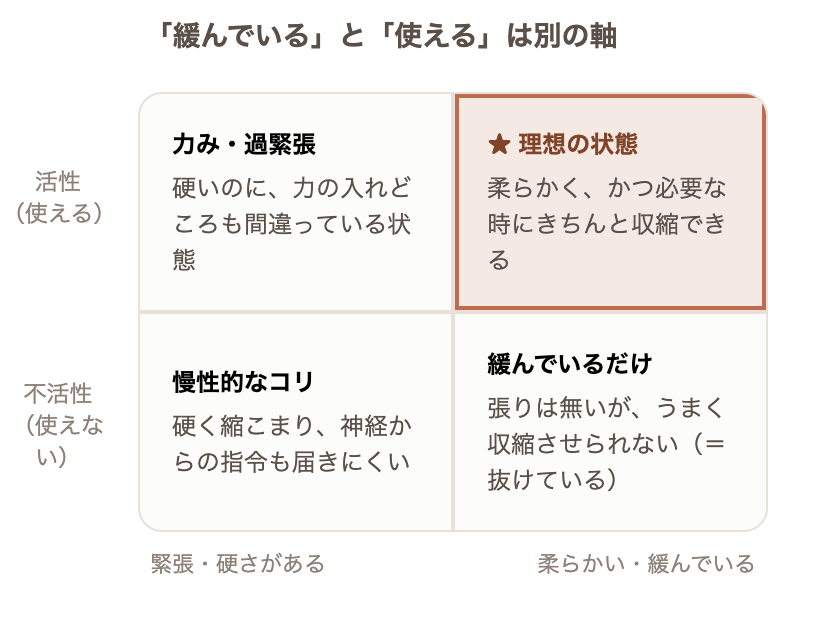
"I'm working hard, but I can't feel the results." "My shoulder stiffness and lower back issues keep coming back." — The cause may not be a lack of muscle strength, but a weakened connection between the brain and the muscles. At our facility, before strengthening the muscles, we place importance on first creating a state where they can be used correctly. That is the concept behind Muscle Activation.
What is Muscle Activation?
"Getting your muscles ready to work."
Rather than simply loosening tight muscles, we focus on the connection between the brain, muscles, and nerves, restoring the correct function of the muscles that should be working. Using AI motion analysis and motion capture-based movement analysis, we visualize how the body moves, and objectively assess muscle function and movement patterns through movement analysis grounded in biomechanics. Based on this data that visualizes physical function, we correct the balance between weakened muscles and overworking muscles, aiming to restore the correct kinetic chain and improve muscle output. These assessment results are then reflected in data-driven training, connecting to scientific training tailored to each individual.
- Glutes aren't activating → strain concentrates on the lower back
- Core isn't functioning → shoulders and neck become overtight
- Unstable feet → strain spreads to the knees and hips
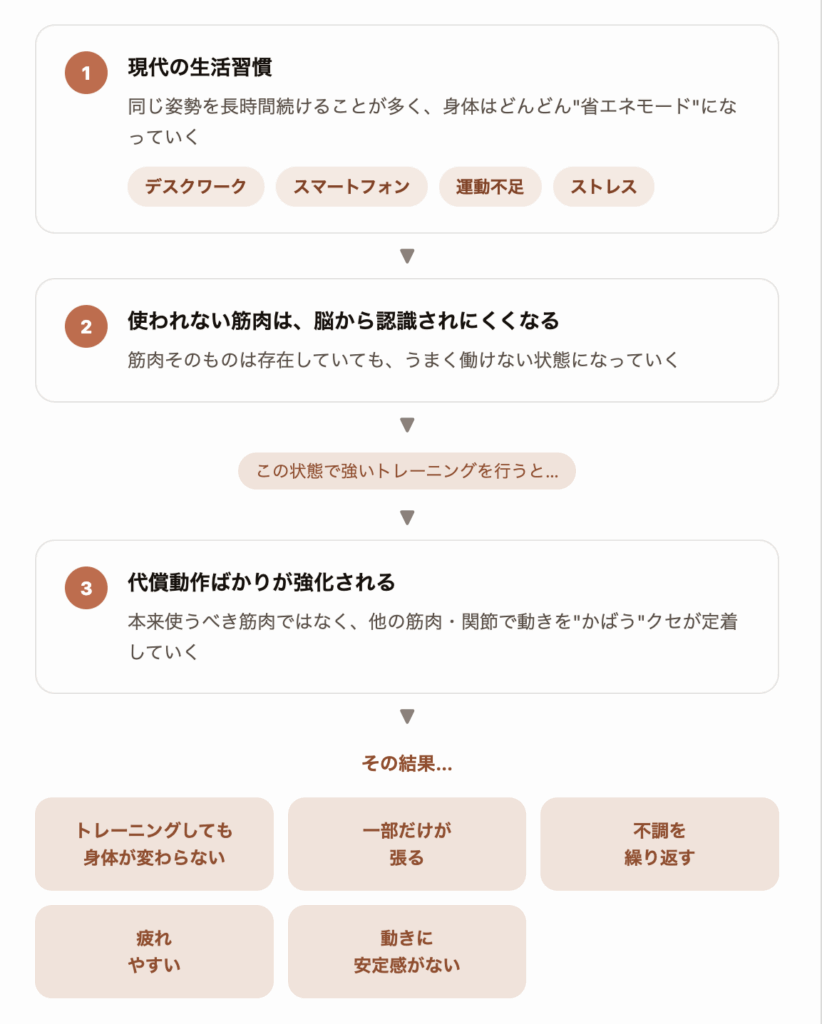
When desk work, smartphone use, and lack of exercise continue, muscles that go unused become harder for the brain to recognize. Training with heavy loads in this state ends up reinforcing compensatory movements rather than the correct muscles — resulting in a body that "doesn't change, no matter how much you train it."
② Why Muscle Activation Is Necessary
Modern bodies have an increasing number of "muscles that can't be activated."
Desk work, smartphones, lack of exercise, stress.
Modern lifestyles often involve staying in the same posture for long periods, causing the body to gradually shift into an "energy-saving mode."
As a result, unused muscles become harder for the brain to recognize — and even though the muscle itself is still there, it ends up unable to work properly.
Training hard in this state can end up reinforcing compensatory movements, rather than the muscles that should actually be working.
As a result,
- The body doesn't change, no matter how much you train.
- Only certain areas feel tight
- Discomfort keeps coming back
- Fatigue sets in easily
- Movement lacks stability
— all of which can result.
That's exactly why what matters most is this: "Before you strengthen your muscles, first get them working correctly."
Our Approach
Step 1. Physical Assessment
We check posture, range of motion, muscle output, and movement patterns to analyze which muscles have lost proper function.
Step2. Muscle Activation
By stimulating the nervous system, we activate muscles that have become difficult to engage — reconnecting the brain and the muscles.
Step 3. Re-Education Training
We retrain the activated muscles within real movement patterns, guiding the body toward naturally choosing the correct way to move.
The Body We're Working Toward
Improved Posture
Reduced shoulder stiffness and lower back strain
Improved movement efficiency / Enhanced performance
Reduced fatigue
Building a body that doesn't give in to age
「"Which muscles are you using — and how?"
That's what determines whether your body changes or not.
Toward a body that can move comfortably, no matter your age. It starts with knowing your own body's condition.
Powered By


FAQs
Q. Who comes to our facility?
A. Our clients are mainly in their 40s and older, coming to us for a wide range of goals — including many who simply want to start exercising for their health.
Those who are beginning to notice a decline in their physical strength
Those experiencing discomfort from desk work
Those concerned about changes in metabolism or body shape, and more.
Q. How often should I come to see results?
A. Coming once or twice a week is most effective.
We offer efficient 30- to 60-minute sessions designed to fit easily into the busy lives of people in their 40s.
Q. What kind of training do you offer?
A. Our program combines posture improvement, core training, flexibility work, and strength building — an "Align × Strengthen" approach.
We don't jump straight into heavy loads — we prioritize building a body that can move well first.
Q. Is it by appointment only?
A. Yes, our facility is by appointment only. Please contact us by email with your preferred date and time.